Sunday, 13 May 2012

Woolwich: Faded Glory

So much of London has been gentrified, even since I've been here.  The property boom of much of the 2000s led to lots of rather humdrum suburbs becoming newly-desirable, and awash with organic wooden toys and hand-fired single-varietal macchiatos.

Whilst the impression may be an inexorable improvement, it seems rather that this may be part of London's natural ebb and flow.  So, I thought I'd explore some of London's less-loved areas, keeping an attentive eye out for former grandeur.  Hence Woolwich.

Approaching from the West, the impeccably-dressed cyclist comes across the William Morris Estate.  God knows why it's named after a proponent of local crafts and workmanship, as the estate is made of Danish system-built prefab point blocks and slabs (the same type that collapsed at Ronan Point in '68).


 Underlining the meanness of the site, the mainline railway track cuts through the estate but doesn't stop there.


There's the train you can't get on.


This type of building is wildly unfashionable. But on a sunny winter's morning, the well-endowed cyclist could nearly infer the architect's efforts to play with light.


Moving further west, one comes across the rather attractive water feature of stagnant rain collecting on the happy space / roof of the communal garage block.


A bit further towards the town, the devastatingly-charismatic cyclist passes through a mish-mash of Victorian, 30s and 50s housing, and chances upon a particularly exciting public house, which is clearly the centre of the local community.


Wow, that many forthcoming events?

A touch further West, the witty and yet international homme en bicyclette chances upon the first real signs of lost glory, in the shape of some superb 30s buildings, now sadly in really horrible states of disrepair.  Gateway House, a rare piece of Streamline Moderne (which might be my favourite type of Art Deco), was once an Odeon, and is now a New Wine Church.


Why do I always have lampposts in my photos?


Across the road is the Grade II-listed Granada, which was once billed as the 'most romantic theatre ever built'.  It's now a Gala Bingo.


Oh hai lamppost (which is strangely of a different design to the one on the other side of the road).


The Royal Arsenal Cooperative, another great bit of Deco, is now derelict.


Sob.


Passing through the mainly-50s pedestrianised parade of shops, the plucky adventurer comes across a timewarp Sainsbury's, all brown and orange and low-ceiling'd.  It looks in my photo as if the block of flats on the left is connected by a flying walkway to the lift tower of the multi-storey carpark above Sainsbury's...  Surely that can't be right.  Surely.


All shops in Woolwich must be clearly signalled by massive orange arrows (Bye law 1.26.2).


At the far end of the shops is a post-Millennium public realm, with a whopping TV on stilts to help placate the grunting masses.  The sloping square has thoughtfully been subdivided by multi-level wedges of grass, again helping to assuage the English fear of open spaces.


Saluting any picture of Cameron on the TV is obligatory (Bye law 1.26.3).


The teasingly-wonderful urban raconteur has, of course, saved the best of Woolwich till last.  In the middle of the shops, an observant and well-muscled chap can find the area's principal tourist attraction - the world's 3000th McDonald's - the very first in the UK.  It's like looking upon the face of God.


 Mr Ray A Kroc later went on the manufacture a range of vile rubber shoes.

Saturday, 12 May 2012

Stirling: Pre-Post Modern

So.  Post Modernism is back.

I'd actually meant to blog about the PoMo extensions to the Tate on Millbank and the National Gallery up at Trafalgar Square.  It occurred to me that I've lived within ten minutes walk of the Tate for about three years, yet can only think of a couple of times that I've bothered to go in (#philistine).  Likewise, I reckon I've been into the James-Stirling-designed extension, the Clore Gallery, but really can't remember much about it.

But whilst Googling the Clore, I came across a Gurniad aticle which noted that another, much earlier, Stirling building was just 15 minutes' bike ride away.  So, I thought I'd have a look at that, as a warm-up up the Tate.

Hiding near Camberwell, the dining and assembly hall for Brunswick Park School was designed in the late fifties, with Stirling's then-partner, James Gowan.  It's made up of three prism-like blocks of glass and light brick, with the fourth corner of the site marked by a chimney (which is presumably located above the kitchens).


There's a really strong 45 degree axonometry here.  You can see the graph paper's impact on the design.  The grass verge rises steeply to the perpendicular curtain wall of glass, which then falls back to the raised ground level.  The geometry is continued by the triangles of internal beams.  This drawing captures the whole effect perfectly.


Taken from Flikr


I find it hard to imagine how space-age and modern the Stirling building must have looked to late-50's eyes.  Whilst looking a bit shabby now, this was a strikingly different architecture to the rather sensible Victorian pile of the school's main building.


Surprisingly sympathetic UPVC windows.


Without getting inside the dining hall, there 's not much more to say about it.  Other than the way that the axonometric angles and glass of the Brunswick building foreshadow Stirling's later, larger, red-tiled and better-known works at Leicester, Cambridge and Oxford Universities.


The Leicester University engineering faculty building, 1959-63.
Looking something like a space rocket on a launch pad.


The Cambridge University history faculty building, designed 1963.


Oxford's The Queen's College's Florey building, looking like a Space Invader, designed 1968.


There's clearly quite a lot of form-over-function these red-tile-and-glass shapes (the wings of the Cambridge building apparently hinting at an open book, from which knowledge is pouring out).  I wonder how that bodes for an art gallery.

But the above buildings were a couple of decades before Sitrling's Post-Modernist Clore gallery...  So I shall go and look at that.

Sunday, 6 May 2012

Hatefilled Hatfield

With some regret, I have finally completed the set of New Towns orbiting London.  There've been tears of joy (the outdoor escalator in Basildon), unexpectedly high-quality tower blocks (Bracknell, Harlow), and wailings of genuine distress (Kodak Tower in Hemel - I still need to blog about that).

The order was entirely arbitrary, but Hatfield, a few miles south of the lush greenery of Welwyn Garden City, came up last.  Whilst I'd been pretty lucky with the weather during my other the-only-tourist-since-1961 New Town sallies, the trip to Hatfield was grey and dreary and a bit cold.  Perhaps that has adversely affected my view of the place.  Perhaps.  That, or Hatfield New Town is really horrible.

Firstly, it was deserted.  Completely.  Not even distressing Bracknell was quite so dismal.


Nothing to say.


No-one to say it to.


After appearances on the Roland Rat Show dried up, Erol's career went downhill.


The 50s New Town square and precinct have been completely killed off by the ring-road plastic PoMo shed of the Galleria.  But before you reach that, there are a few signs of sort-of life, in the form of more fucking plants (cf Bracknell), and a charity shop/brothel.


The Triffids ill-advisedly chose Hatfield as the site for their invasion of the Earth.


A cyber lady points to her sexy loins, sexily, in the window of a 'charity shop'.


Much like the other New Towns, Hatfield has plans for regeneration of the town centre.  'Phase One', a hoarding announces, 'will be the creation of two new buildings... creating a complete High Street leading down to Asda'.  Ah - so that's what's lacking from the town centre.  If only the original architects had included two more buildings, then the High Street would've been complete, and all would be well.  The whole scheme (um, 5 shops and 15 flats) comes with the dismal caveat 'as market conditions improve'.


Why would the original proposals not have allowed town centre regeneration to be delivered?


I include here a now-and-later imagining of how a nearby tower block will look when rendered and whitewashed.

Oh noes the drab present  :'(


Teh future's!!1


The piss-poor / propaganda Photoshop alleges that the dazzling tower will actually be a light source, casting shadows behind the Happy People as they bask in its urban realm.

So, onwards, via the 24 hour Asda, to the Galleria.


All lower case?  Good, because that will never date.

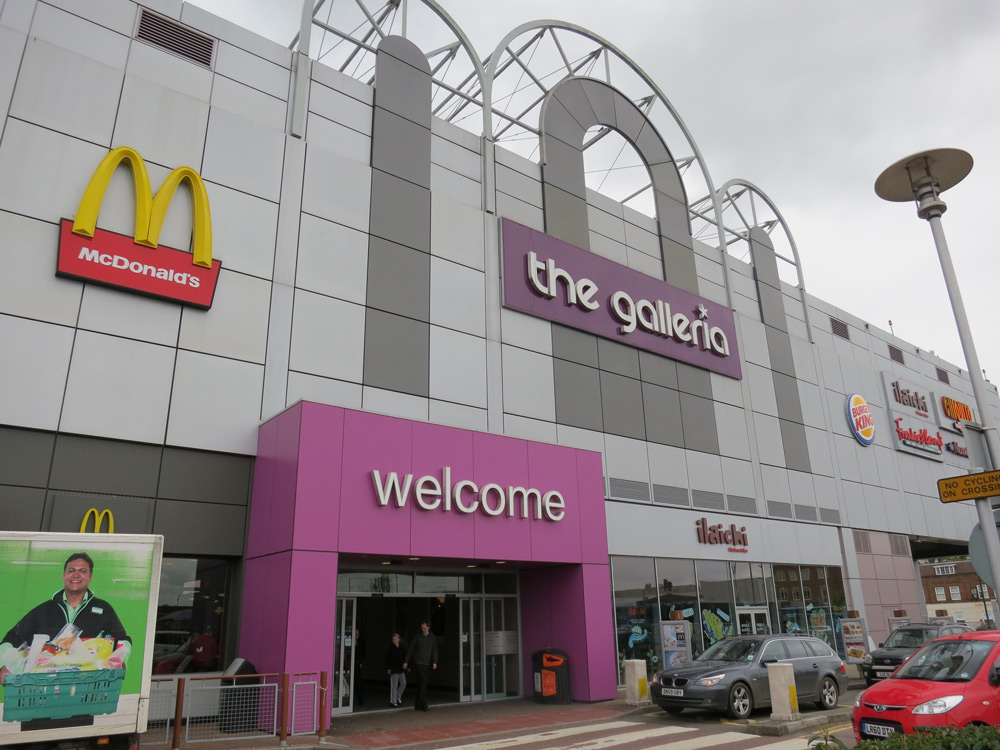
Loosely apeing the curved metal arched roofs of Stanstead, the Galleria manages none of the light airiness of Foster's work, and is cluttered with hanging lights and a random divider of fabric.


Most oddly, the Galleria (I'm refusing not to use a capital letter) has almost no useful shops, being some sort of Bicester Village (urg) stylee 'Outlet Park'.  Only the Superdrug saves the whole enterprise from being completely superfluous to human needs.

On the way back to train station (hourly fast trains to Kings Cross, for those keen to escape), I came across some cryptic graffiti.


After much deliberation, my best guess is that is that is says 'Steve writing on walls is', but that Yoda-speaking Steve spelt his name wrong.  An enthusiastic knuckle-dragger has added a further 'Devvo' of support.

In Hatfield, the mouthbreathers are looked upon as the elite.


Saturday, 10 March 2012

Retro: the East London Line

The below is a lightly-tweaked bit of flotsam written in 2008, by me and my chum @urpert.  It was published in the excellent London journal Smoke thenabouts.  I'm putting it here to correct some of my criticism in implying that the East London Line is only of use for those going from Anerley to Shoreditch.  Indeed, the new ELL has the best and most functional rolling stock of any London train line.  Furthermore, the reopened line can, of course, also be used to go from Brockley to Wapping.  


Standing at a pre-Christmas Whitechapel Station with a very cold face and beery breath, I checked my watch again and continued waiting for the train to arrive. Taking only 15 minutes end-to-end, and comprising just 8 stations, the East London Line seemed a far more manageable pub crawl than a suicidal multi-binge on the Circle Line, or hours spent trying to find the Monopoly's Coventry Street to get a pint there. Furthermore, the ELL was shortly to be parked in the sidings until June 2010, so this was one of the last few days that I could think of a reason to use the stunted little tartrazine-coloured line. However, with fewer trains than even the piss-poor (and pink) Hammersmith and City bothers to run, this crawl involved more sobering up and standing around than I'd expected.

My only other experience of the ELL was after an ill-advisedly large lunchtime curry on Brick Lane. Waddling around with a madras-packed phantom pregnancy, I decided that it'd save vital footsteps to catch a train south from Shoreditch, rather than stagger to Aldgate East. This, bafflingly, required waiting for the station to reopen after its lunch break. I then stood, alone, on the single platform with nothing to look at but a mysterious tunnel through which the trains didn't run. The tracks, sprouting grass and in a trench of neglected Victorian brickwork, looked like a giant unloved Hornby set. Only after some time did an errant Metropolitan Line train, having perhaps taken a wrong turn at Chesham [posh] and ended up in Tower Hamlets [grim], finally arrive to carry my pendulous, spiced belly back towards civilisation.


I'll have a standard curry, please.


Perhaps the ELL is one of those amusing but crap quirks of London history, like Lambeth North station or the entirety of Notting Hill. Running awkwardly along the right hand side of the Journey Planner, the ELL was the only Tube line not to enter Zone 1; it thoughtfully prevented itself from becoming overcrowded and/or useful by being the only Tube line not to serve a real London terminus. Which was done deliberately to take the piss out of Fenchurch Street, one presumes.


Useful.


Of interest to the historically-inclined, the ELL bravely chuffed through the pioneering Thames Tunnel, as carved by Brunel's Dad using only his bare forearms and a teaspoon (or something). As a wizened, salt-of-the-earth East Londoner, the ELL has lived through many world-shaking events, including World War II and the Thatcherite moulding of once-proud Surrey Docks into the plexiglass portal to foulness of Surrey Quays Shopping Village and Lifestyle ExperienceTM.


A ring-road symphony of PoMo in brown.
What a nice vernacular hat that tower is wearing.


When it re-opens in 2010, the ELL will be subject to some inventive re-branding by TfL, placing stations in Underground-starved South London literally on the map. Unlike the late-90s Jubilee Line extension, no fresh tunnelling is required to complete the ELL; rather, it will be made by linking together existing bits of mainline track and changing over some station signs to form the tangerine flagship of the London Overground (currently boasting indirect services to hateful parts of North London, at least twice daily). This first phase of the extension will link Croydon [pregnant chavs] to Hoxton [foolish haircuts] and beyond, via Canada Water's curiously literal interpretation of the Journey Planner's right-angle interchange with the Jubilee Line.

The alleged second phase of ELL construction, which currently has no money and no schedule for building, will allow estate agents to abuse us with the notion that there will shortly be a Tube line running directly from Clapham Junction to Islington. This will delight the stupid and/or northern bumpkins who believe these are the only two places one can live in London. Of course no-one, ever, will actually make that journey; not deliberately, anyway. At least being on the East London Line will be more useful than being on the much-vaunted 'Meridian Line', which presumably led to a lot of disgruntled commuters in Hither Green ['up and coming'] finding themselves stuck with no useful transport links to anywhere other than Dartford [edgy] or Orpington [neglected].


Textbook example of drunken lamppost photography.
Incidentally, New Cross and Canary Wharf are in the background.


Finally ensconced in a naff 70s New Cross armchair in a tediously expensive student pub, I drank my tediously expensive 'World Lager' (Heineken) amid faintly embarrassed students with asymmetric haircuts, each of whom wished the ELL had already been completed so their barnets could be conveyed on the fast, efficient service to Hoxton. I admired the view of the New Cross station shed, the flashing light atop Canary Wharf blinking lonely morse into the night, and thought of the imminent demise of the forked orange lifeline of a very small area of South East London. I drained my glass and set off towards the Romulus of the ELL's princely twin termini, New Cross Gate, one last time.

 Farewell, old friend. I am pissed and you were orange.


Friday, 2 March 2012

London buses: less rubbish

For many, the shape of London changed when the extended East London Line opened in 2010, literally putting parts of SE and E London on the (Tube) map.


The southern parts of the Phase One extension.


Not that the line actually goes anywhere particularly useful - unless there is a significant crowd from Anerley heading up to Shoreditch for some lager shandies (or - who knows - a sizeable crew from Shoreditch heading down to the equally-grubby Anerley).  Still, it forms part of the Orbital Route that will eventually connect up to Clapham Junction, which will at least bring some colour to [the map of] South London.

Nonetheless, the accessible parts of London remained in the minds of many Londoners (and tourists) a multicoloured skeleton, albeit one with a slightly-longer orange bone.  Venturing away from those vital routes was a risky business - bravely essaying into the grey-and-white-striped hinterlands of, gulp, Not On The Tube.  Here be dragons / Thamesmead.

But, TfL has delivered a service that will improve the average public-transport-user's life by just under infinity percent - a reliable indicator of how long you'll have to wait for a bus in London.  A proliferation of smartphone apps now allow users to wait in the warm and dry, and away from the other dreadful hoi-palloi who [have to] use buses, for as long as possible, before making a perfectly-timed arrival to board the horror shuttle to wherever they have somehow decided to go, despite that place not being on the Tube.


ZOMG, improbably, there's even a Windows Phone app.


Having used such apps a few times, I can only say that they i) are fucking awesome, and ii) allow you to see  quite how  randomly  spaced  London   buses can    be.

(A little typographical joke there).

In addition to this, frankly brilliant, development, TfL this week also unveiled the prototype replacement for the old Routemaster bus, the Borismaster (or, prosaically, the New Bus for London, as I refuse to call it).

I quite accept that the old Routemasters were iconic, and the ability to leap on and off the back in slow-moving traffic was great in such a congested city.  But I found them basically unusable as I'm too long of leg to either stand up, or sit down, on the bloody things.

And so, with some likeminded and lightly-beered chums, I staked out Victoria Station to await the only one of the prototypes to be running on London's streets.  Best of all, because we're sprightly and sharp of elbow, we got the front window seats on the top deck.  And I could fit my legs in - win.


The Borismaster nuzzles into the rear of a Normal Bus.


The innards of the bus are clad in red and mustard-gold plastic, which made the whole thing feel a bit like it's sponsored by McDonald's (cf the entire Olympics).


The ribbon windows parallel the (rather plasticky) staircase.


I rather liked the design of the PoMo moquette - both a rather pleasing visual joke about the contour lines of a seat that has sagged under the weight of a million London arses, and a knowing nod to computer-aided design, anti-aliasing and interpolation.  It is no accident that a pattern that is intended not to be noticed copies the CAD hatching that depicts transparency.


It gets a bit trippy if you look at it for too long.


An earlier account of the Borisbus noted that the backdoors had been left shut owing to a software error.  Whilst they were open all the time we were aboard, the LCD Next Stop scrolling board did keep making errors.


Borisbu
This won't play on iPhones. Ahahahahah.


An old Routemaster, from the window of the Borismaster.
The circle is now complete: when I left you, I was but the learner, etc.


The key to the Borismaster is of course the rear exit, which allows Londoners to leap off into the path of oncoming traffic, etc.  Although, presumably to appease the (rather sane) requirements of Health and Safety, there is a second member of crew on board to ensure that Londoners don't end up balanced on the precarious platform, or tumbling under the wheel of passing juggernauts.


The rear boarding platform.  Where you're not allowed to stand.


Whilst I never had any trouble with the much-vilified Bendybuses (I was never even once so much as crushed to death by one), I do rather like the Borismasters.  Sure, they feel a bit cheap and plastic, but so do all buses, and at least that means that the blood wipes off easily, after you've been stabbed for asking some scrote not to throw chips at your girlfriend.

I do wonder, however, about the political future of the Borismasters.  Many of the rewards that BoJo is currently reaping come from the work of the previous Mayor, Red Ken - such as winning the London 2012 Olympics, and the extension to the East London Line that I began this piece with.  Perhaps following the May elections, Mr Livingstone will have the opportunity to deliver a whole fleet of shiny new Kenmasters to the streets of the Captiol...

Saturday, 11 February 2012

Foreign: Copenhagen

When heading from Copenhagen airport to the centre of town, I decided to eschew the direct train, and go a slightly more protracted route on the new Metro.  In fact, as the Metro doesn't serve Central Station (presumably putting it on a strategic par with Fenchuch Street), I also got to go on one of the mainline suburban trains too.


The Danes like their design, and like the neighbouring country of Ikea, they like things minimal.  The trains are large and wide, and the floating seats allow easy cleaning of the floor (which was slushy with melted snow and grit).  But this unrelenting efficiency makes them a little characterless, feeling a bit like a cross between the plastic delights of the Croydon Tramlink and the DLR.  Although, like the DLR, you can go right to the front and pretend to drive / be taking off from Battlestar Galactica.  Should that sort of thing roll your stock.


Yes, camera, please focus of the scratched graffiti,
rather than the tunnel.  Thank you.


The Metro stations also seem to be of a uniform design.  Symmetrical escalators zigzag up towards the skylights, whilst the metal-panelled walls make the whole place feel a bit surgical and cold.  But nonetheless hi-tech and pleasantly shiny.


Rather cutely, the arrivals boards count down in half-minutes.


Another bit of escalator porn, for those that way inclined.


The suburban trains were also massively wide, and quite unlike British trains, were happy to carry bicycles.


Note that although loads of people in Copenhagen cycle, none wear helmets.  These seems somehow at odds with the high-pay, high-tax Welfare State system in which you can't even buy booze from an off-license after 8pm lest you get tipsy and fall in the sea.

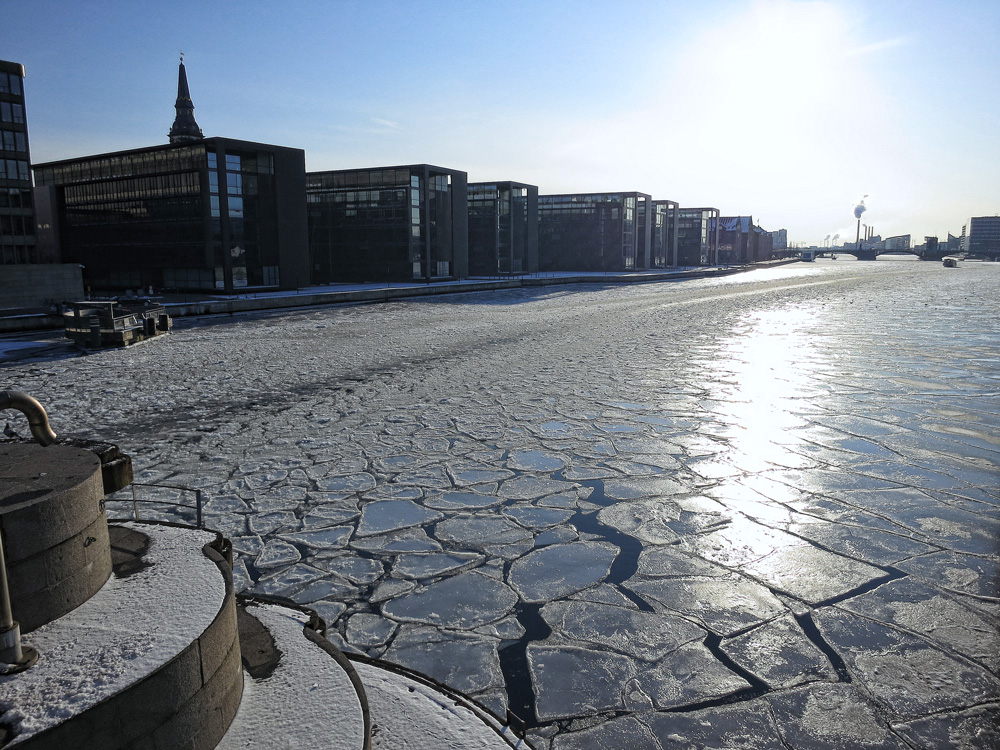
I had hoped to take a river taxi too, but the canals had frozen over.  It was cold.


I thought that expanse of white was a field.  
Actually, it's a frozen and snowed-over lake...


Tuesday, 24 January 2012

Shopping: how to make people buy stuff #1


Make your sign look like nice handwriting by someone
who can't do cursive 's's.


1) Make a pun about your food being bland;
2) Use a font that looks a bit 50s and a bit like Comic Sans Bold.


Create some art that looks a bit like a spine.


Sell from a portacabin.
Everyone loves portacabins.


Spell the name of your shop wrong.