Showing posts with label Suburbs. Show all posts

Thursday, 3 July 2014

This is England (the A232)

Hello, well done and thank you, dear Reader.  Welcome to your very own cut-out-and-keep guide to English domestic architecture.


Well, sort of.

Rather, perhaps, a tour of the humid, sordid joys of suburban housing. You, smart, sexy Reader, will certainly recognise that the spectrum of styles covered below is likely to surround you. A ubiquity of limited proliferation.  In order to demonstrate that these building types can be found pretty much anywhere, and not necessarily out of laziness, I have limited the exploration below to the corridor between East Croydon station and West Wickham, known with good cheer as the A232.

Empire

Our first era together. I shall be gentle and yet thorough, my soft, diaphanous Reader.

I'm using the term Empire to cover off a large swathe of Victorian and Edwardian architecture. Empire was when England was Great.  Has anyone ever described themselves as Great British?

In this particular instance, the area to the north-east of East Croydon station is largely Empire, presumably knocked-up to cater for the burgeoning middle-class clerks (sort of ur-yuppies) drawn to the area by the fast rail links to London Bridge and Victoria (the latter opening in the 1860s).


The above view is entirely typical.  Bay windows - some single storey, some double - with mullions decorated to look like Grecian columns.  Completely not-in-keeping, the bays often evoke a castle's turrets. Clearly, laudanum was freely available to all commuters (a sort of ur-Starbucks).


This late-period fantasy is wonderful and bonkers in absolutely equal measure.  A large lovely pile of large lovely nonsense, all hanging tiles and big windows, topped with terracotta gargoyles and, superbly, sporting a full-on fairytale tower.  Let it never be said that our forebears were overly restrained or uncomfortably buttoned-up.  This is a vulgar as vulgar can be, without perhaps the addition of some bass-relief of priapic nudity, or a tasty 400-point imprecation gouged into the walls.

An Englishman's home is his castle, hence the moat (garden), barbican and drawbridge (porch and path to the front door) and turret (turret).

Arts and Crafts and thence Tudorbethan


Proper Arts and Crafts stuff here. It's in part a rejection of the mass-produced nature of Victorian industry (in both senses), a return to a simpler, twee-er time. There's a lower, more cottagey feel, with somewhat-laboured the impression of craftsmanship in the twiddly details (look at those chimneys twist into the sky!). It's precisely the same impetus as that which fuels the current trend for Farmers' Markets: now that one can acquire a bewildering range of world goods from any given ringroad Omnimarket, the middle-classes are drawn towards new ways of displaying their wealth and excellent taste by buying purportedly traditional English things. Such as £8 quiches, drizzled with a tasty jus of organic, rustic, artisanal, seasonal, unpasturised, single-varietal, hand-made, sour-dough, free-range, locally-sourced, rare-breed epithets. It's a way of inventing a history, of faking old-money - of pretending to be of landed stock (or, at least, an honest farm owner). And this is terribly important to the Englishman or lady.


A later exercise in the same very-English pretence. A sizeable and immacuately-maintained bit of Tudorbethan, with crown green-perfect lawns and an in-keeping garage. It's even got a wishing well (!) in the curiously-generous front garden.


The style was also applied, somewhat surreally, to parades of shops. Here we have Ye Olde Wimpy (est 1928) on Wickham High Street.

Moderne (-ish)


There's not a lot of Moderne along this route. Perhaps this suburban setup of Zone 5 appealed more to larger families, who preferred the more traditional stylings of Tudorbethan built at much the same time. But here is an example of a building, four single-floor maisonettes by the look of things, with a nod towards fashionable Moderne. The original central windows would have been sexy curved sun-trap windows (sadly now angular UPVC), with horizontal glazing bars and just a few vertical member. The clean white horizontal band is a sort of go-faster stripe to pair with the streamlined windows. But, other than those, it's a largely conventional building with hipped roof and unrendered brick. A safe version of the future, still recognisably English.

Episode IV: A New Hope

The aftermath of the war gave architects the opportunity to try new things. Or, rather, it gave them time to think about what new things they'd want to build once the post-war building regulations were relaxed. Once they were, in 1954, we were treated to an optimistic compromise - a new way of living, but on the cheap (cf the valiant efforts of all the New Towns to build a new world on a budget).


This is a rather pleasant little block.  Notice that the weight is not being taken by the road-facing walls.  This 'free elevation' means you can do what you want with the outside: in this instance, have windows that run along the entire front and side of the building, including that rather sexy unsupported corner. There doesn't seem to be a chimney stack either, suggesting that the building came with some sort of space-age heating system, like an asbestos-lined CFC-burner, emitting infra-red heat and ionising radiation in equal measure.


Further rule-breaking.  The jaunty roof-line emphasises the buzz-saw frontage that affords each shop a few more square-footage of glass in which to display its wares.  Groovy.
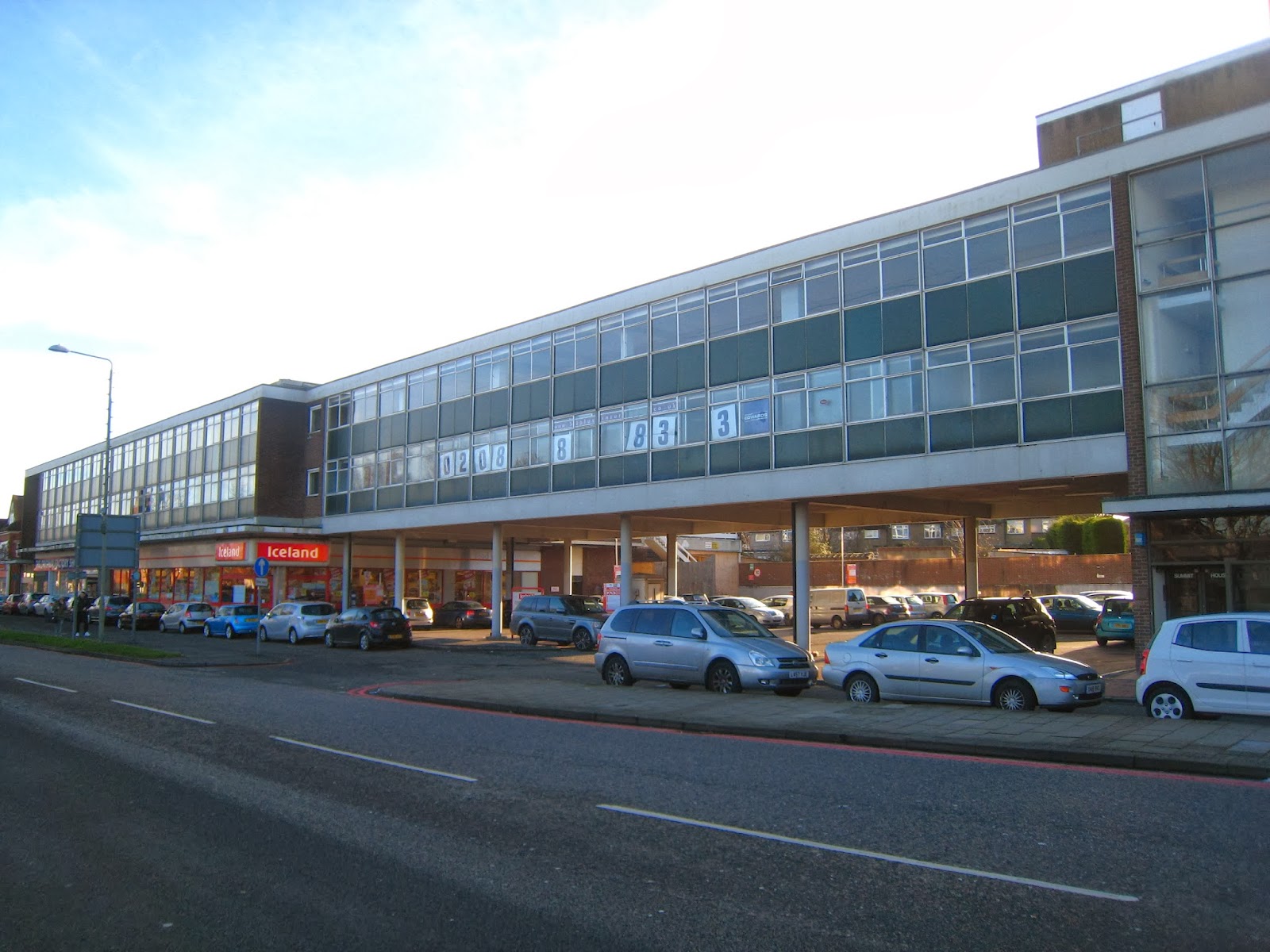

Another demonstration of what was once state-of-the-art engineering.  Building-width strips of windows and huge panes of glass in the stairwells allow as much light in as the English climate permits us.  It looks like the office space at the top is deserted.  Frankly, I'm still impressed that the whole central section of that block can be supported on so few slim columns.  Note, however, that these buildings are deeply unfashionable and can therefore only attract cheapy tenants, like Iceland and The Original Factory Shop - compare with mummy-friendly M&S, which likes to take up new-builds (see below) or fashionably stylish buildings like Art Deco ex-cinemas.

Comforting stodge: vernacular (and PoMo)


Oh dear.  After all that scary optimism, we slid back into making things look a bit like old things. Here're some retirement flats in the style of a row of thatched cottages. Small windows, and an upstairs you can't stand up in properly. Genius. 


This, however, rather superbly bridges the gap between fashionable retro and 80s fashions - the blue-frame square-pane glazing to the left meets an Olde timber-clad gable (enlivened by the jazzy yellow chevron announcing the then-exciting thrill of Sunday opening).


The ground floor of this Sainsbury's also emulates the roof line of thatched cottages, but tops it with some dead-eyed nuclear bunker / gun-slit combo.  Happy shopping, comrades.


Part of PoMo's schtick was re-introducing Classical forms after all that New Hope stuff. These mock-Georgian terraces (we're back to vertical windows again) are decorated with wire-frame triumphal arches for some reason. Perhaps you can grow strawberries up them. The top gable window sort-of describes a split pediment.  Japes.


I think this is much newer, but the mindset is the same. A freakishly overgrown corner tower (topped with a rustic weather-vane) in a Venetian style (why not?), with an adjunct archway in render.  But this is of course quite consistent with English architecture - it's more important that the building borrows old forms, than that they necessarily make any sense together.

My argumentation here, which is essentially a unifying philosophy for much of English domestic architecture, has limits. Take a look at the pair of terraces below. On the left is a row of bargain-basement Victorian houses.  They are of meagre proportions, and come with just a pair of simple windows (no light-gathering bay windows here) and not even a single terracotta gargoyle.  The front garden is just a slither of space, keeping the passing pedestrian literally at arm's length.


Demonstrating face-hurting stupidity, the designer of the new-builds to the right chose to clone these impoverished hundred-year-old originals, despite the old ones being of zero architectural merit.   Even then, the clones' windows are somehow even pokier.  This is the sort of lazy crap that makes me want to dismember the architects' pets (and possibly those of the current residents, as a warning to those who support the market for this retrophiliac cack).

There is now at least somewhere to put the bins.  Hoorah for progress.

After Post-Modernism


What's not to like here?  Perhaps a roof-line to induce sea-sickness, the already-faded wood cladding, and the grimy porridge-beige render.  And such sophisticated details as the high-visibility guttering downpipies (see how it crunches awkwardly over the corner of that twee porch).  And nowhere to put the bins other than the front garden.  And the tartrazine-orange front doors.  Oh, and the bloody coaching lamps.  Come, friendly bombs and fall on the A232.


And, of course, after Post-Modernism comes good old-fashioned Modernism.  Here, M&S pretends to be in 1920s Germany.

Whimsy


What is more English than daft, aspirational excess?  Here, a tiny bungalow with full-on pedimented arch.  And net curtains.  And partially off-street parking.  Win.

Sunday, 11 November 2012

Sutton: All suburban shopping Bar None

Sutton is the home of the first All Bar One.

Despite this, or perhaps because of this, it is quite well-connected by trains.  Thusly, the curious and devilishly handsome urban explorer can get there with ease from, say, Kings Cross, Victoria, Blackfriars or, um, Mordern South.

Turning right out of the station [the direction, rather than necessarily with urgency] one toddles along a long downward sloping High Street, where rainwaters must cascade in those monsoon-season summer months.

One's eye is caught by a bit of suburban concrete brutalism; one might even fail at first to notice that someone had planted the first floor with shaggy grasses.  Perhaps it's a tribute to the Olympic Park.  But why is the floor above it partly open to the elements?  Is it a car park, once you've driven through the office space behind?  A Corbusier-style sun terrace with a roof?  A horrible, horrible mistake?


One soon comes across a nice bit of artificial stone PoMo, which looks like it might be a shopping centre, but is actually just a facade that extends well above the two-floor shops in it.


Shortly further on, one comes across a real shopping centre.  One which appears to have been modeled on the 1980s Space Lego Monorail set that I used to [/still] want.


Sutton's Times Square Shopping Centre


Legoland set 6990


Someone's putting in some valiant effort with Times Square.  The Christmas decorations are rather pleasant, with blue fairy lights matching the Lego canopy, but there are a heck of a lot of empty shops.


The heads of the hanged Christmas trees were left as a warning to others.


Things are livened up somewhat by a really grim 'Happy Happy Yellow' flying walkway that links the shopping centre to the multistorey carpark out back.  It looks like that acetate sheeting that shopkeepers used to stick on the inside of their windows to keep their haberdashery from fading in the sun.


Happy now?


Back across the High Street is yet another indoor shopping arcade, the one which presumably killed off the Times Square one.  This sports a rather impressive bit of heroic Gill Sans bursting forth into the winter sky.


Reminds me of Nova Huta


The St Nicholas shopping centre has all the most mediocre high street brands that the low-aspiring surburbanite could want (Next, Debenhams et al).  There's also a pleasingly over-the-top central dome bit bursting with bunting.


Happy Jubilee / Olympics / shopping


On the way back to the train station, one passes a pleasant example of small-town punning.  One can spend the entire journey back to London proper pondering [that's 'London-proper, pondering', not 'London, proper pondering'.  I don't speak like that] its hidden meanings.


A reference to 'dress to impress'?
A reference to Avis' 'We Try Harder'?
Just a bit illiterate?

Sunday, 13 May 2012

Woolwich: Faded Glory

So much of London has been gentrified, even since I've been here.  The property boom of much of the 2000s led to lots of rather humdrum suburbs becoming newly-desirable, and awash with organic wooden toys and hand-fired single-varietal macchiatos.

Whilst the impression may be an inexorable improvement, it seems rather that this may be part of London's natural ebb and flow.  So, I thought I'd explore some of London's less-loved areas, keeping an attentive eye out for former grandeur.  Hence Woolwich.

Approaching from the West, the impeccably-dressed cyclist comes across the William Morris Estate.  God knows why it's named after a proponent of local crafts and workmanship, as the estate is made of Danish system-built prefab point blocks and slabs (the same type that collapsed at Ronan Point in '68).


 Underlining the meanness of the site, the mainline railway track cuts through the estate but doesn't stop there.


There's the train you can't get on.


This type of building is wildly unfashionable. But on a sunny winter's morning, the well-endowed cyclist could nearly infer the architect's efforts to play with light.


Moving further west, one comes across the rather attractive water feature of stagnant rain collecting on the happy space / roof of the communal garage block.


A bit further towards the town, the devastatingly-charismatic cyclist passes through a mish-mash of Victorian, 30s and 50s housing, and chances upon a particularly exciting public house, which is clearly the centre of the local community.


Wow, that many forthcoming events?

A touch further West, the witty and yet international homme en bicyclette chances upon the first real signs of lost glory, in the shape of some superb 30s buildings, now sadly in really horrible states of disrepair.  Gateway House, a rare piece of Streamline Moderne (which might be my favourite type of Art Deco), was once an Odeon, and is now a New Wine Church.


Why do I always have lampposts in my photos?


Across the road is the Grade II-listed Granada, which was once billed as the 'most romantic theatre ever built'.  It's now a Gala Bingo.


Oh hai lamppost (which is strangely of a different design to the one on the other side of the road).


The Royal Arsenal Cooperative, another great bit of Deco, is now derelict.


Sob.


Passing through the mainly-50s pedestrianised parade of shops, the plucky adventurer comes across a timewarp Sainsbury's, all brown and orange and low-ceiling'd.  It looks in my photo as if the block of flats on the left is connected by a flying walkway to the lift tower of the multi-storey carpark above Sainsbury's...  Surely that can't be right.  Surely.


All shops in Woolwich must be clearly signalled by massive orange arrows (Bye law 1.26.2).


At the far end of the shops is a post-Millennium public realm, with a whopping TV on stilts to help placate the grunting masses.  The sloping square has thoughtfully been subdivided by multi-level wedges of grass, again helping to assuage the English fear of open spaces.


Saluting any picture of Cameron on the TV is obligatory (Bye law 1.26.3).


The teasingly-wonderful urban raconteur has, of course, saved the best of Woolwich till last.  In the middle of the shops, an observant and well-muscled chap can find the area's principal tourist attraction - the world's 3000th McDonald's - the very first in the UK.  It's like looking upon the face of God.


 Mr Ray A Kroc later went on the manufacture a range of vile rubber shoes.

Friday, 16 December 2011

Foreign: Krakow (Nowa Huta)

As part of it's 2011 EU Presidency bumf, Poland has put together a free English-language paperback advertising the delights of Poland, its cities and its citizens ('About Polska').  It's mainly anodyne and harmless sub-propaganda ('We see ourselves as friendly, welcoming folk' etc etc), encouraging tourists to pop over and spend some dosh before the EU implodes and the Euro becomes the Deutsch Mark Mk II.

Amongst its pages on the Krakow, the book mentions a place called Nowa Huta, describing it as 50s 'social engineering experiment' that is now 'a troubled district...that fascinates with its grandiose Stalinist architecture'.  As a high-risk tourism venture goes, it's up there with London advertising 'Come to Norwood Junction - it's edgy.  There are chicken bones.  Mmm'.  But, having nearly collected the full set of English 50s New Towns, I thought I'd take the opportunity to see how the Socialists did urban planning back then.

The whole settlement of Nova Huta was inflicted on the middle-classes of Krakow, for their refusal to vote for Uncle Vladimir in a post-war referendum.  The idea was to balance out the vile Krakowiak bourgeois with some honest-to-goodness salt-of-the-earth Workers.  Hence the New Town was focused on a steel works - a vast complex, which once held the largest blast furnace in Europe.

The receptionist at the hotel was clearly somewhat dismayed that I was asking how to get to Nowa Huta, rather than the walled charms of the Old Town.  She told me I could catch a tram directly Howa Huta, but was unable to tell me how I'd know when I'd actually reached there...

So I got off the tram sort-of at random, on the basis that I had passed the picturesque kitsch of the Old Town some time ago (and a couple of really horrid PoMo shopping centres).  I could see some post-war 50s-ish buildings, so hoped I might be in the right sort of area.  These point blocks look distinctly similar to the medium-rise things we have dotted around the UK (particularly now they're adorned with satellite dishes).  So far, so not very exciting.


'...grandiose Stalinist...'?


But, fortuitously stumbling (I was well off the tourist maps of Krakow here) upon the main square of Plac Centralny, I found the huge radiating boulevards of Socialist Realist blocks - 6-storey rendered and arcaded rows of apartments and ground-floor shops.


That's my shadow in the bottom right.
I appear to be saluting.


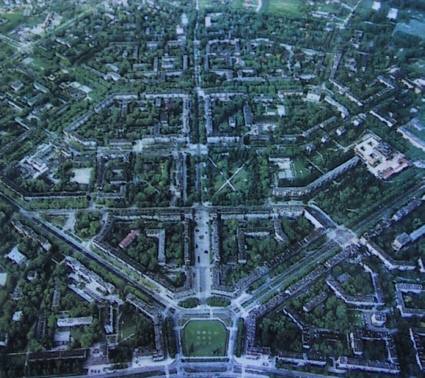
This aerial shot shows the design of the development - with the Plac at the bottom, the main avenues fanning out, with housing blocks filling up the spaces in betweeb.


 Copyright: teh internets


I mentioned before how social and political ideas are so often manifested in the buildings of the time.  For example, English New Towns like Welwyn Garden City were built with swathes of trees and parks as a reaction to the dense slum housing of the industrial revolution, to enhance the quality of life for the residents.  As an added bonus, and quite terrifyingly, the greenery of Nova Huta was included to help soak up the radiation from the feared nuclear war; the wide streets would prevent the spread of apocalyptic fires; and the layout of the housing blocks meant that the city could be turned into a walled fortress with comparative ease.  Serious stuff.


According to a slim volume I later bought from the one-room Howa Huta Museum, these blocks were originally pretty dismal inside, with 'no central heating, no sewage system...the floors were simply lined with bare, unplaned planks'.  That said, in the setting wintery sun, the blocks looked a little like the cute pastiche of somewhere like Welwyn (although, as if the punchline to a Victoria Wood skit, rather than a whopping great steel plant, Welwyn had a Shredded Wheat factory). Presumably completing the aims of this design, the outside of the blocks looked quite attractive to a Prole like me.

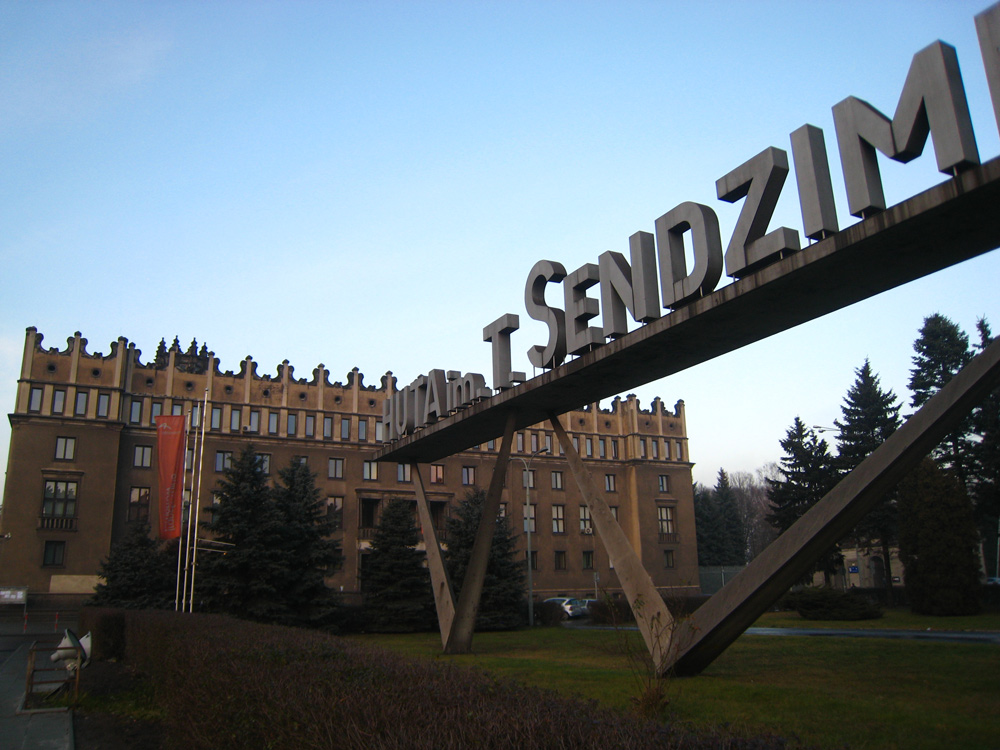
Off to the east of the main housing matrix lies the eponymous steel works, its huge on-stilts signage rising up from the trams' power cables.  From a distance, it looks a bit like Croydon's Ikea.


Ampere Way, Communist style


The administrative blocks standing of either side of the sign are topped with a comb attic of renaissance details, nodding to the fluted stylings of the Old Town buildings.  The steel works - apparently still in operation - are closed off behind some gates.


Amazing bit of sans serif on dynamic stilts.


Broken ice floated on the surface of the Nowa Huta lake, as I headed back towards the warmth of the hotel.  It was cold.


Saturday, 9 July 2011

Eltham: City of Mouthbreathers

Took the bike out to Eltham last weekend.  Ostensibly, I was off to see Eltham Palace, but it was shut when I got there at 11am.  So I amused myself by looking at the lovely 30s houses round there.  A particular and pink one caught my eye:


A magnificently horrid mess (marvel at the curved once-suntrap windows that arc round to the garage extension!  Gasp at the pink, Old Worlde porch extension!  Feel slightly nauseous on behalf of the neighbours and their unruined house on the left).  Oh, those lanterns.

Anyway, whilst taking pictures and chortling in a horribly superior way, a young skinheaded chap stopped his van and asked me if I was trying to break into his Mum's house.  Least he asked, I suppose.  Anyway.  I had to claim to be admiring the stylish architecture.  And then I ran away on my bike.