Showing posts with label New Towns. Show all posts

Monday, 7 October 2013

A [nightmare] vision of Britain: Poundbury

The below is a clip from a late-80s TV programme, in which Prince Charles laments the fate of London's once-beautiful skyline at the hands of post-war (re)building(s).  'Can you imagine the French doing this sort of thing in Paris?' he taunts, fomenting NIMBY fury in the vague direction of modern architecture.


HRH Chaz is very much a fan of old (or old-looking, anyway) buildings.  He elsewhere described a proposed extension of the National Gallery as a 'monstrous carbuncle on the face of a much-loved and elegant friend'.  Regardless the architectural merits of the extension, to call the lumbering stodge of the National Gallery 'elegant' is simply inane.  It's greatest rival for London's Most Insipid Neoclassical Wank is, natch, Buckingham Palace.

In the vid above, His Chazness decries Birmingham's (old) Central Library as looking 'like a place where books are incinerated, not kept'.  But what should a library look like?  What cultural symbol or language clearly announces a building's purpose?  Should a library looks like a giant book?  Or be entirely clad with books?  Have a large enough sign proclaiming LIBRARY to be totally unambiguous?

In response to the horrors of the Twentieth Century, and indeed, half of the Nineteenth, Chaz allowed an 'unashamedly traditional' sort-of New Town to be built on his lands, just to the west of humdrum Dorchester.  Poundbury: an idealised mock-Georgian 'urban quarter', a sort-of English Amish wonderland in which time stopped a couple of hundred years ago.

At first, Poundbury seems rather fun.  Swinging off the A35, the eye is caught by the Fire Station HQ, shaped like a Georgian version of a Greek temple.  And the drill tower is in the Venetian sytlee.  Tee hee!  How very silly.  But surely, Chaz, a fire station should be in the shape of a flame.  Or some water.


There are no painted road markings, no traffic lights, few signs, and a uniform set of period streetlamps.  Only replica Georgiana is permitted.


What becomes clear, however, is that Poundbury is not fun.  It may look like Chessington World of Adventures, but Poundbury takes itself very, very seriously.  There's a sterilised, totalitarian approach to everything.  It's clearly ridiculous, and yet no-one seems to be admitting it.  The experience is rather uncomfortable, like straight-faced panto.  Featuring on-stage incest.

And it goes on.  Streets and streets of particoloured brick-and-render, punctuated with bigger set-piece bits of silliness.


And there are cars.  Cars parked on the street everywhere.  There are some efforts to hide these, but the Georgians only had stable blocks, not garages or - heavens forbid! - multi-storey car parks.  And so Poundbury becomes trapped in its own Luddite rhetoric, and cannot permit any solution other than large, dead, confused spaces, such as the car park / main square / void outside Waitrose


The natural bricolage of place, usually driven by history and economics, here comes baked-in.  Artifices implying bricked-up windows are included in Poundbury new-builds because there was once a window tax in England.  Who would deliberately want less light in their house?  There's probably some inversely snobbish appropriation here too - the homeowner frugally choosing to brick up windows to minimise his/her tax bill - but when the houses are this expensive it's manifestly daft.


The below, cropped from the Rightmove world in which the sky is always blue, shows an end-of-terrace that comes ready-made with an 'extension' and a 'loft conversion'.  The house acquires a sense of age at the expense of practicality (say, the ability to stand up properly in the top floor, or storage space in the loft).  A fantasy heritage that is just as silly, and just as po-faced, as designer jeans that come ready-ripped.


What appear to be a single house is often purpose-built flats.  The fact that such destructive divisions, motivated by rising land prices and rising house prices, have been wrought on genuine Georgian houses by property speculators is surely something to be lamented, not something to ape in a new-build development not in the same way constrained by space.

Wandering around, I thought a few touches of Modernism had somehow sneaked under the eugenic radar.


But on reflection, Poundbury has not admitted real plurality, but rather appropriated and rewritten this unwanted aspect of history.  This result is a genetically re-engineered Modernism, a mutant form of the movement that remained centripetally drawn to the past.  A fantasy in which Corbusier limited himself to four piloti, and recognised that any building without a coaching lamp is dangerously subversive.


And it just stops.  Incomplete Poundbury becomes hinterland.  


There's a creepy, quasi-apocalyptic nothingness, a moat of wilderness around the town.  Which is, quite plausibly, deliberate.


Perhaps most, the picking-and-choosing irritates me.  If you want to live in a Georgian world, you should have to do it properly.  Cars should be banned, thereby making the place far more picturesque.  Maybe the water should be enriched with cholera. And maybe the air perfumed by some giant tuberculosis nebuliser.  Yes.

It terrifies me that the next King of England thinks that the last two hundred years were entirely a bad thing.  This does not bode well for the future.

Poundbury is the scariest place I have ever been.

Monday, 16 September 2013

Bracknell revisited

Like you, I have often laid awake at night, starched pyjamas in parlous disarray, milky Horlicks growing tepid, pondering which of the London-circling New Towns is the worst.

It's not Harlow.  Definitely not Basildon.  My sleep-addled mind proposes Hatfield, with its deserted plazas and horrible motorway-spanning mess of an outlet mall.

But, of course, it's Bracknell. Poor, poor rubbish Bracknell.

The Powers That Be try to keep you away - the train there stops absolutely bloody everywhere en route - for your own good. But the brave / daft tourist can get there if he displays enough vim and spunk and doesn't get arrested for so doing.  And, because I'm a fan of the underdog / desolation, I went back, almost two years to the day since my first trip.

Again, it was drizzling in Bracknell.  I do like a good spiral ramp up to a multistorey car park, looming like a concrete lighthouse to guide travellers to the safety of the shops.  It's a shame that Bracknell doesn't have one.

The train station is the most poxy and boxy of all the New Towns.  It's got an office block popped on top, pigeon-spikes tastefully decorated with an urban art installation.

Bracknell cares.

Like all good New Towns, the pedestrian can avail him/herself of a network of underpasses from the train station to the shops.  This being Bracknell, the underpasses are decorated with depictions of hanging baskets of flowers (the eidetic reader of this blog, or one with good taste, will recall that hanging baskets are hideous).  Sigh.


The main square (Charles Square) has, as ever, been filled with a mess of glass-canopy escalators, street furniture and other vile clutter.  It's like a pastiche of the naffest bits of Coventry.

Thanks for that

There's also a water clock, which shows the time once every five minutes, and for the rest of the time is just decorative.  The idea makes my brain hurt.

Oh, it's either 29:04 o'clock or it's not

Princess Square, the basically rubbish indoor shopping bit, is being restyled and has sadly lost its amusingly overblown entrance canopy thing.

September 2011

September 2013

The regeneration masterplan is in various stages.  The first, honestly, is to build a Waitrose.  Social engineering lives!  The plans for the revamped Charles Square are a bit grim.  Which is, I suppose, in keeping for Bracknell.


It's not all bad.  St Joseph's church opposite Princess Square is a little gem -  a clean, simple A-frame structure, immaculately maintained.  And actually open, which, empirically, is unusual for a church.


Also fun is the sort-of out-of-town retail park which has a lovely, lovely bit of yellow-frame PoMo, with (bless!) a little pyramid hat on.  Grubby!  Shame really that the Odeon inside has been refurbed and isn't in its original livery.


For some reason, I imagine that Bracknell is like the Outer Circles of Hell. Not actually horrible, like the infernal torments reserved for estate agents, but just consistently unpleasant.

I shall leave you, sweet reader, with a photo taken in another of Bracknell's underpasses.  Lovely.

WHY ARE WE HERE?

Saturday, 28 July 2012

Ebbsfleet: it were all fields round here

For some years, Ebbsfleet has been the (rather lame) bane of my life. It's the place that ruins Eurostar journeys. There I am, spread out like some kind of two-seat gentry, when a Kentish bumpkin boards at Ebbsfleet International, sits next to me, and thusly two hours of silent wresting for the arm-rest ensue. Oh what fun.

Whilst there's a station, Ebbsfleet isn't really a place yet.  So far, it's a potential New Town for the north Kent 'Thames Gateway'.  It's already served by the first High Speed train line (the one that doubles as the Javelin service for the Olympics).  There's a masterplan which shows what the proposed Ebbsfleet development might look like. When looking at the Battersea Power Station plans, I noted that the architects / propagandists had sometimes greyed out undesirable features, such as train tracks that run alongside proposed apartment blocks.  Here, the High Speed line is of course a draw for Ebbsfleet (indeed they've greyed out the roads) - but note the apparently vacant area in the far right of the image below...


...Google maps reveals that's a sewage works, that is.  Let's hope there's never an easterly breeze.


Ebbsfleet International station itself is an almost featureless glass box, sitting amidst a somewhat Tellytubby rolling green countryside.  The vista is only somewhat marred by the pylons lurking on the hilltops.


The station is served by allegedly-exciting Fastrack buses (Fast Rack?  Fasttrack?), which run to Bluewater shopping centre in the west, and Gravesend to the east.  So I went to both (which cost £6.  Bloody provincial fares).

Approaching Bluewater, the road loops down into a huge chalk quarry pit.  You are not allowed to arrive by foot.  The shopping centre has something of a theme park feeling about it, being surrounded by huge expanses of car park.  The front (if there is one - anyway, the way I went in) is strangely the weakest part, or, perhaps, that which has dated the most badly.  


The silver wire-frame structure of standard PoMo shapes (pointy, pyramidy, towery) looks like a particularly pretentious greenhouse.  Perhaps it is - it's called the Winter Garden, although any signs of greenery were hoarded off for refurbishment during my visit.

But just wait until you get inside (darling).  Bluewater, dear reader, is awesome.  It is perhaps the most attractive shopping centre I have ever seen.

Each of the sides of the sort-of triangle that makes up Bluewater is styled differently, and beautifully.  For example, the 'Guidhall' side is lined with 'sculptures' of artisans (weavers, glaziers, poulters, and the like).


The 'Rose Gallery' side has excerpts of poetry embossed on girders up by the high, bright roof, beneath a trellis of roses.  


A spur from the triangle, the 'Village', is darkly Historicist, all rich woods and glossy surfaces.


It leads to a water feature, some more ur-Tellytubby grass, and buildings wearing a dunce's hat and a Rubics cube.


Oh, PoMo, your jokes will never get old.  No, wait...


Back inside, each of the centre's 'corners' has a skylighted dome with sculptures and light pouring in.


The whole effect really is lovely.  There an almost high-Victorian thoroughness to the styling - everything that could be carved or emphasised or designed, is.  Even the poles that are strung with Jubilee / Olympic / woohoo-it's-summer bunting are different on each side.

Then again, given this is PoMo, I wonder whether all the styling is supposed to be taken ironically.  After all, there is no actual rose garden here, rather a post-industrial brownfield site topped with tarmac.  None of the goods for sale were made by the artisans captured in the sculptures, rather mass-produced for the lowest price in far-East factories.  Read differently, the massive Trajan simplethink poetry has a whiff of 1984 about it...


Repeat: I am happy in the dales of Kent.


Whilst the buildings are lovely, I've no doubt that shopping here is a vile experience on a busy weekend.  Luckily, the bedraggled shopper can then take the Fas Track bus to a quiet place, the enticingly-named estuarine town of Gravesend.  Mmm.

From there, on a hot summer's day, the lucky Kentish folk can bask in the sun and enjoy the views of Tilbury Power Station across the estuary.  


There're two cast-iron piers.  One is closed because it's a restaurant; the other is closed because it's owned by the Port of London Authority.

There is a statue of Pocahontas, because everyone in Kent loves Disney.

There are also signs of redevelopment.  Fingers crossed it'll be completed soon.


Sunday, 6 May 2012

Hatefilled Hatfield

With some regret, I have finally completed the set of New Towns orbiting London.  There've been tears of joy (the outdoor escalator in Basildon), unexpectedly high-quality tower blocks (Bracknell, Harlow), and wailings of genuine distress (Kodak Tower in Hemel - I still need to blog about that).

The order was entirely arbitrary, but Hatfield, a few miles south of the lush greenery of Welwyn Garden City, came up last.  Whilst I'd been pretty lucky with the weather during my other the-only-tourist-since-1961 New Town sallies, the trip to Hatfield was grey and dreary and a bit cold.  Perhaps that has adversely affected my view of the place.  Perhaps.  That, or Hatfield New Town is really horrible.

Firstly, it was deserted.  Completely.  Not even distressing Bracknell was quite so dismal.


Nothing to say.


No-one to say it to.


After appearances on the Roland Rat Show dried up, Erol's career went downhill.


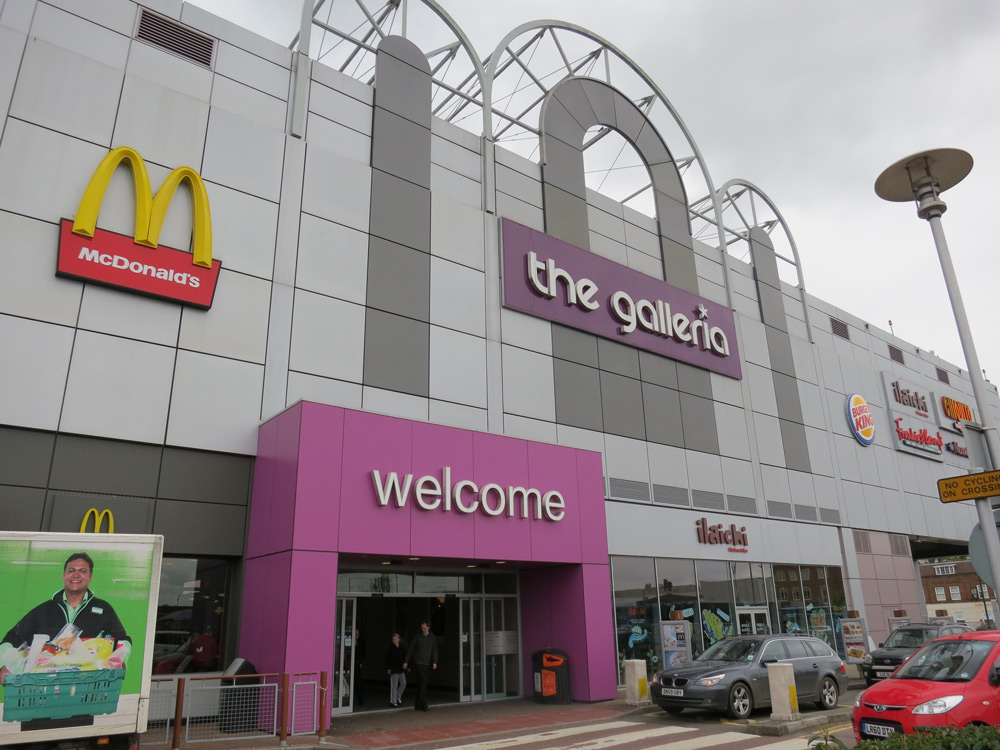
The 50s New Town square and precinct have been completely killed off by the ring-road plastic PoMo shed of the Galleria.  But before you reach that, there are a few signs of sort-of life, in the form of more fucking plants (cf Bracknell), and a charity shop/brothel.


The Triffids ill-advisedly chose Hatfield as the site for their invasion of the Earth.


A cyber lady points to her sexy loins, sexily, in the window of a 'charity shop'.


Much like the other New Towns, Hatfield has plans for regeneration of the town centre.  'Phase One', a hoarding announces, 'will be the creation of two new buildings... creating a complete High Street leading down to Asda'.  Ah - so that's what's lacking from the town centre.  If only the original architects had included two more buildings, then the High Street would've been complete, and all would be well.  The whole scheme (um, 5 shops and 15 flats) comes with the dismal caveat 'as market conditions improve'.


Why would the original proposals not have allowed town centre regeneration to be delivered?


I include here a now-and-later imagining of how a nearby tower block will look when rendered and whitewashed.

Oh noes the drab present  :'(


Teh future's!!1


The piss-poor / propaganda Photoshop alleges that the dazzling tower will actually be a light source, casting shadows behind the Happy People as they bask in its urban realm.

So, onwards, via the 24 hour Asda, to the Galleria.


All lower case?  Good, because that will never date.

Loosely apeing the curved metal arched roofs of Stanstead, the Galleria manages none of the light airiness of Foster's work, and is cluttered with hanging lights and a random divider of fabric.


Most oddly, the Galleria (I'm refusing not to use a capital letter) has almost no useful shops, being some sort of Bicester Village (urg) stylee 'Outlet Park'.  Only the Superdrug saves the whole enterprise from being completely superfluous to human needs.

On the way back to train station (hourly fast trains to Kings Cross, for those keen to escape), I came across some cryptic graffiti.


After much deliberation, my best guess is that is that is says 'Steve writing on walls is', but that Yoda-speaking Steve spelt his name wrong.  An enthusiastic knuckle-dragger has added a further 'Devvo' of support.

In Hatfield, the mouthbreathers are looked upon as the elite.


Friday, 16 December 2011

Foreign: Krakow (Nowa Huta)

As part of it's 2011 EU Presidency bumf, Poland has put together a free English-language paperback advertising the delights of Poland, its cities and its citizens ('About Polska').  It's mainly anodyne and harmless sub-propaganda ('We see ourselves as friendly, welcoming folk' etc etc), encouraging tourists to pop over and spend some dosh before the EU implodes and the Euro becomes the Deutsch Mark Mk II.

Amongst its pages on the Krakow, the book mentions a place called Nowa Huta, describing it as 50s 'social engineering experiment' that is now 'a troubled district...that fascinates with its grandiose Stalinist architecture'.  As a high-risk tourism venture goes, it's up there with London advertising 'Come to Norwood Junction - it's edgy.  There are chicken bones.  Mmm'.  But, having nearly collected the full set of English 50s New Towns, I thought I'd take the opportunity to see how the Socialists did urban planning back then.

The whole settlement of Nova Huta was inflicted on the middle-classes of Krakow, for their refusal to vote for Uncle Vladimir in a post-war referendum.  The idea was to balance out the vile Krakowiak bourgeois with some honest-to-goodness salt-of-the-earth Workers.  Hence the New Town was focused on a steel works - a vast complex, which once held the largest blast furnace in Europe.

The receptionist at the hotel was clearly somewhat dismayed that I was asking how to get to Nowa Huta, rather than the walled charms of the Old Town.  She told me I could catch a tram directly Howa Huta, but was unable to tell me how I'd know when I'd actually reached there...
So I got off the tram sort-of at random, on the basis that I had passed the picturesque kitsch of the Old Town some time ago (and a couple of really horrid PoMo shopping centres).  I could see some post-war 50s-ish buildings, so hoped I might be in the right sort of area.  These point blocks look distinctly similar to the medium-rise things we have dotted around the UK (particularly now they're adorned with satellite dishes).  So far, so not very exciting.


'...grandiose Stalinist...'?


But, fortuitously stumbling (I was well off the tourist maps of Krakow here) upon the main square of Plac Centralny, I found the huge radiating boulevards of Socialist Realist blocks - 6-storey rendered and arcaded rows of apartments and ground-floor shops.


That's my shadow in the bottom right.
I appear to be saluting.


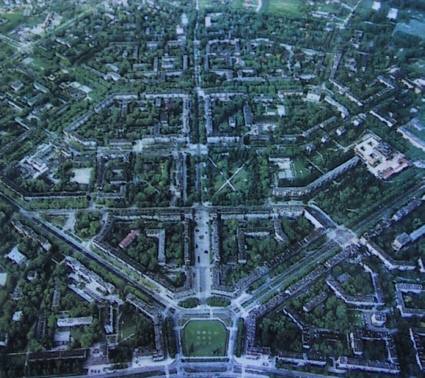
This aerial shot shows the design of the development - with the Plac at the bottom, the main avenues fanning out, with housing blocks filling up the spaces in betweeb.


 Copyright: teh internets


I mentioned before how social and political ideas are so often manifested in the buildings of the time.  For example, English New Towns like Welwyn Garden City were built with swathes of trees and parks as a reaction to the dense slum housing of the industrial revolution, to enhance the quality of life for the residents.  As an added bonus, and quite terrifyingly, the greenery of Nova Huta was included to help soak up the radiation from the feared nuclear war; the wide streets would prevent the spread of apocalyptic fires; and the layout of the housing blocks meant that the city could be turned into a walled fortress with comparative ease.  Serious stuff.


According to a slim volume I later bought from the one-room Howa Huta Museum, these blocks were originally pretty dismal inside, with 'no central heating, no sewage system...the floors were simply lined with bare, unplaned planks'.  That said, in the setting wintery sun, the blocks looked a little like the cute pastiche of somewhere like Welwyn (although, as if the punchline to a Victoria Wood skit, rather than a whopping great steel plant, Welwyn had a Shredded Wheat factory). Presumably completing the aims of this design, the outside of the blocks looked quite attractive to a Prole like me.

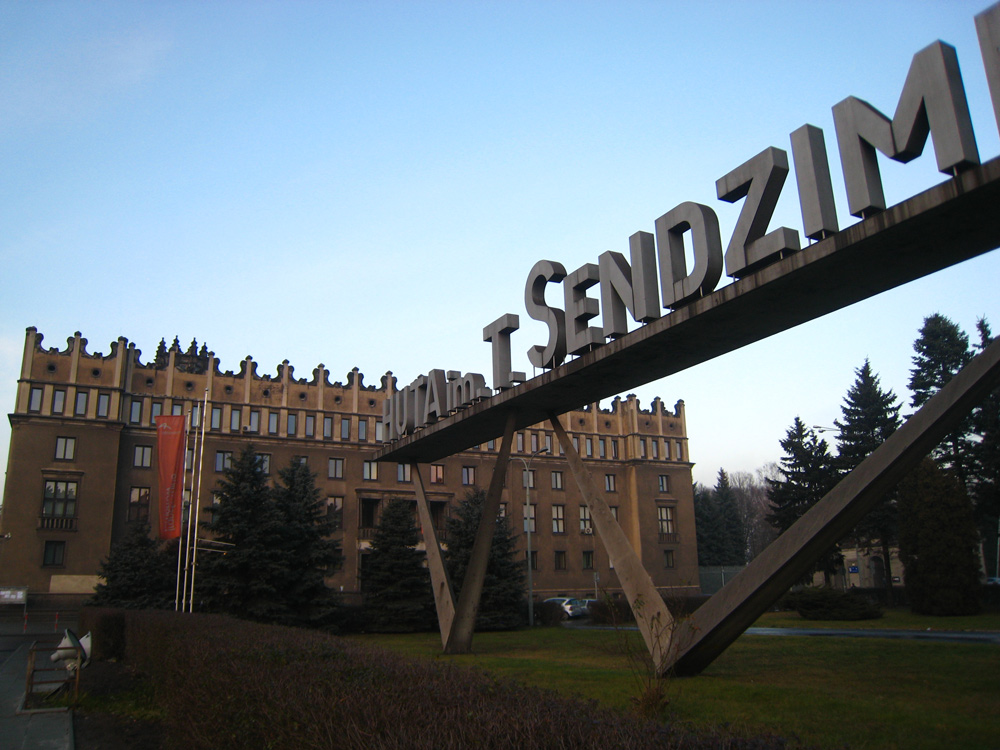
Off to the east of the main housing matrix lies the eponymous steel works, its huge on-stilts signage rising up from the trams' power cables.  From a distance, it looks a bit like Croydon's Ikea.


Ampere Way, Communist style


The administrative blocks standing of either side of the sign are topped with a comb attic of renaissance details, nodding to the fluted stylings of the Old Town buildings.  The steel works - apparently still in operation - are closed off behind some gates.


Amazing bit of sans serif on dynamic stilts.


Broken ice floated on the surface of the Nowa Huta lake, as I headed back towards the warmth of the hotel.  It was cold.