Saturday, 28 July 2012

Ebbsfleet: it were all fields round here

For some years, Ebbsfleet has been the (rather lame) bane of my life. It's the place that ruins Eurostar journeys. There I am, spread out like some kind of two-seat gentry, when a Kentish bumpkin boards at Ebbsfleet International, sits next to me, and thusly two hours of silent wresting for the arm-rest ensue. Oh what fun.

Whilst there's a station, Ebbsfleet isn't really a place yet.  So far, it's a potential New Town for the north Kent 'Thames Gateway'.  It's already served by the first High Speed train line (the one that doubles as the Javelin service for the Olympics).  There's a masterplan which shows what the proposed Ebbsfleet development might look like. When looking at the Battersea Power Station plans, I noted that the architects / propagandists had sometimes greyed out undesirable features, such as train tracks that run alongside proposed apartment blocks.  Here, the High Speed line is of course a draw for Ebbsfleet (indeed they've greyed out the roads) - but note the apparently vacant area in the far right of the image below...


...Google maps reveals that's a sewage works, that is.  Let's hope there's never an easterly breeze.


Ebbsfleet International station itself is an almost featureless glass box, sitting amidst a somewhat Tellytubby rolling green countryside.  The vista is only somewhat marred by the pylons lurking on the hilltops.


The station is served by allegedly-exciting Fastrack buses (Fast Rack?  Fasttrack?), which run to Bluewater shopping centre in the west, and Gravesend to the east.  So I went to both (which cost £6.  Bloody provincial fares).

Approaching Bluewater, the road loops down into a huge chalk quarry pit.  You are not allowed to arrive by foot.  The shopping centre has something of a theme park feeling about it, being surrounded by huge expanses of car park.  The front (if there is one - anyway, the way I went in) is strangely the weakest part, or, perhaps, that which has dated the most badly.  


The silver wire-frame structure of standard PoMo shapes (pointy, pyramidy, towery) looks like a particularly pretentious greenhouse.  Perhaps it is - it's called the Winter Garden, although any signs of greenery were hoarded off for refurbishment during my visit.

But just wait until you get inside (darling).  Bluewater, dear reader, is awesome.  It is perhaps the most attractive shopping centre I have ever seen.

Each of the sides of the sort-of triangle that makes up Bluewater is styled differently, and beautifully.  For example, the 'Guidhall' side is lined with 'sculptures' of artisans (weavers, glaziers, poulters, and the like).


The 'Rose Gallery' side has excerpts of poetry embossed on girders up by the high, bright roof, beneath a trellis of roses.  


A spur from the triangle, the 'Village', is darkly Historicist, all rich woods and glossy surfaces.


It leads to a water feature, some more ur-Tellytubby grass, and buildings wearing a dunce's hat and a Rubics cube.


Oh, PoMo, your jokes will never get old.  No, wait...


Back inside, each of the centre's 'corners' has a skylighted dome with sculptures and light pouring in.


The whole effect really is lovely.  There an almost high-Victorian thoroughness to the styling - everything that could be carved or emphasised or designed, is.  Even the poles that are strung with Jubilee / Olympic / woohoo-it's-summer bunting are different on each side.

Then again, given this is PoMo, I wonder whether all the styling is supposed to be taken ironically.  After all, there is no actual rose garden here, rather a post-industrial brownfield site topped with tarmac.  None of the goods for sale were made by the artisans captured in the sculptures, rather mass-produced for the lowest price in far-East factories.  Read differently, the massive Trajan simplethink poetry has a whiff of 1984 about it...


Repeat: I am happy in the dales of Kent.


Whilst the buildings are lovely, I've no doubt that shopping here is a vile experience on a busy weekend.  Luckily, the bedraggled shopper can then take the Fas Track bus to a quiet place, the enticingly-named estuarine town of Gravesend.  Mmm.

From there, on a hot summer's day, the lucky Kentish folk can bask in the sun and enjoy the views of Tilbury Power Station across the estuary.  


There're two cast-iron piers.  One is closed because it's a restaurant; the other is closed because it's owned by the Port of London Authority.

There is a statue of Pocahontas, because everyone in Kent loves Disney.

There are also signs of redevelopment.  Fingers crossed it'll be completed soon.


Sunday, 22 July 2012

Best of British (nobody likes PoMo)

The opening of the Shard: typically understated.


TimeOut (you know, that thing that no-one in London reads) is doing its annual Best Building / Worst Building popular-o-meter.

Rather than just letting us all name and shame / phrase and praise [best I could do] any old building, the TimeOut crew have preselected 20 iconic and 20 bad 'bits of architecture'.  This helps us all not have to think too hard.  Or notice that TimeOut is using 'iconic' as an synonym for 'good'.  Hmm.

Anyway, the 'iconic' list can be broken down into a few basic tropes:

- Old / old looking (the Globe, the Tower of London, St Pauls)
- Fairytale Victoriana (St Pancras, Natural History Museum, Royal Courts of Justice)
- Moderne / Art Deco (Hoover Building, Senate House, Battersea Power Station)
- Brutalism (South Bank Complex, Trellick Tower)
- Random novelty (Neasden Temple), and
- The oooh shiny-shinies (the Lloyds Building, the Gherkin, the Shard)

You mustn't think too hard here either, or you'll spot that the 'South Bank Complex' is a cluster of buildings ranging from the simple curve of the 1951 Royal Festival Hall to the oh-god-I'm-trapped-again shuttered concrete mazes of 60s and 70s fundom alongside it.

Familiarity inevitably helped the TimeOut lot select their best buildings. Goldfinger's Trellick Tower is nice enough and has been seen by loads of motorists stuck on the A40 (like the Hoover Building). But the lesser-known and earlier Balfron Tower, done by the same geezer somewhere over near Poplar, is a better bet if you like your Flapjack Brutalism.  Balfron is surrounded by a cluster of other Brutalist slabs and point-blocks, and has a simply terrifying concrete 'playground' at the bottom, which adds to the inhuman, other-worldly nature of the site.


Smile.  Or perhaps don't.


And Balfron thoroughly trumps Trellick in terms of views - the west-facing panorama from a top-floor flat in Balfron is astounding, taking in everything from Battersea Power Station to the City in one glance.


Oh hai all of london!!


A great addition to the shiny-shiny list would be the Canada Water library, which looks like an improbable golden Sandcrawler, leaning towards the Surrey Quays BHS across the lake.  But no-one knows it's there.


And Barratt's Aspiration Wharf 'stunning development'.


Suppose it's too early for any of the lovely Olympics stuff to be included.

The 'bad' list notably only contains things built after 1960 (because everything more than 50s years old is, of course, wonderful).  There's a more Brutalism (the Brunswick Centre, Centre Point, Robin Hood Gardens), and more brand-new stuff (the silly ArcelorMittal Orbit 'sculpture', the new Wembley Stadium, City Hall), and a bit of PoMo (the Millennium Dome, No 1 Poultry, and Farrel's actually rather good MI6 juggernaut).


The City's novelty-socks building.


Undermining any pretence that the whole exercise is anything other than a measure of current fashion and taste, the TimeOut worst list features a few buildings that are also on the best list (the Shard, the Barbican, the South Bank Complex).  

Shockingly, the conclusion might be that some people like some buildings, and others prefer different ones.  Oooh.  Fancy that.

Thursday, 28 June 2012

Southampton

I've used Owen Hatherley's awesome Guide To The New Ruins of Great Britain as a sort-of tour guide for unfamiliar places like Sheffield (which led me to get lost in a distant suburban nowhere of identical 30s semis). He's a lefty Modernist (I shall leave it to you, sweet reader, to determine for yourself whether or not that's a good thing) architecture writer. As a not-deliberate tribute to the imminent publication of his new book A New Kind of Bleak, I travelled down to Southampton, Hatherley's hometown, to look at the port from which the Titanic, and plausibly other ships, sailed.

With curious honesty, the history-facts-are-fun! plaque mounted by the original city walls noted that Southampton was once more than a collection of shops, a pair of Universities, and somewhere for Portsmouth to hate.


Once upon a time.


The massive late-90s West Quay shopping centre takes up much of the centre of town nowadays. Replete with fashionable PoMo ideas like context / reference / sympathy, it looks like a Cubist portrait of a steamliner, all bits of bows and prows and fragments of things that look like sails and rigging.  And, because Southampton had a defensive wall, bits of rubble infill are packed into neat tidy panels at the bottom. Inside, it's white and bright (and hot, on a mild June day - apparently, geothermally-heated), anchored at either end by the Mummy-friendly twin bastions of Marks and Sparks and John Lewis.


For some reason, this looks a bit like the front of a big boat...


As might be expected, this sort of regeneration - a large new shopping centre - modestly expands, and yet also displaces the sustainable number of stores and jobs in the city. It take them away from the established precincts, rather than generating a boundless largess of new riches. And this, dear reader, is the site of seduction for this handsome author.

Just across from Above Bar (no one can tell me for sure whether its 'Above Bar Street' or just 'Above Bar') is the Bar Gate, a late Eighties covered shopping arcade. Bored-looking security guards patrol the inside, keenly protecting the four or five shops that haven't closed, and stopping Southampton's whole clan of Goths from loitering outside the (presumably only) alternative clothing store. I'm used to seeing disused Victorian high streets and 50s shopping precincts, but to see this failure, which in most other places would be the regeneration, is most odd. 


Lovely PoMo detailing on the columns.


Someone's given the whole thing the same dirty-sky-blue paint job that concrete housing blocks are now often daubed when someone seeks to soften their appearance and demonstrate a bit of effort in maintenance / the existence of emulsion.  The flooring is from Brown Tron.


Is 'The Cunard Queens' a transexual strip club or a maritime museum?


At the very bottom of the complex is a perfectly-nice-looking Philippine eatery with no-one in it, which in London one would call it a pop-up diner, if one were preposterously-inclined. Next to it, like a sulky 90s teenager locked in stasis, sits a magnificently-preserved and deserted Gamesmaster / Stargate-era gaming cafe, with fibreglass statues in the Egyptian Space Deco style.  One can, a hoarding announces, play such recent games as CounterStrike: Source (2004).  On the Bargate website, the What's On page is strangely blank.

He's holding teh internets in his hands!!  Shame they're 14.4k hands.


On Above Bar Street is another white-and-escalators shopping centre, the Marlands (the website for which spouts the sort of irritating estate agent twaddle that makes me want to bite my own face off - 'enjoying direct access onto the main shopping street...'). Inside, a charmingly daft feature pretends to a Georgian terrace, presumably providing context / reference / sympathy for the Georgian streets flattened by the Luftwaffe in 1940. This precinct has got the T K Maxx, so it clearly a poor relative to West Quay.


But the most fun comes just past the colossal 50s department store (currently a Debenhams, after Allders went bust) to the east of the main drag. If approached from a wilfully perverse angle, the East Gate (natch) shopping centre begins as a large, brutal car park, and an office block plonked on top (with a stylish spine / DNA helix / fire escape).


Yes, this sits delicately on top of the car park and shops.


Tripping gingerly down the (mmm) staircase, the broad-shouldered adventurer is treated to an amazing combination of depressingly-bright colours (cf Elephant and Castle / the balcony panels in cheap estates that copy the Golden Lane development).


Welcoming.


As not a single shop remains occupied, it looks like this small enclosed precinct will soon be reduced to rubble / ’luxury’ apartments in render.  It seems currently to be used as a cut-through from some unseen car park to the West Quay shops.


My eyes!


Elsewhere in the town, I caught a few other quality sights (/sites) during my swift extra-London sojourn. Next to the half-geniune Deco train station lurks the unloved hulk of Wyndham Court. To my eyes, the ooh-look-it’s-a-bit-like-a-boat is just as cheesey as the West Quay’s aping, but Hatherley seems to like it, so that's okay then.  It's a pretty hardcore piece of Brutalism.


Can I steer the housing block please, Captain?


These holes provide lighting to the car park underneath, and much-needed gaiety and delight to the residents. Cough.


The estate is set in a sloping concrete-slab wonderland, enlivened by a single tree (but notably devoid of people, on a Saturday lunchtime).  There is however an on-site curry house.


Cheap drinks.  One also wonders whether that’s the entire menu.


Another bit of PoMo (gosh, Southampton really does like the stuff) is the De Vere Grand Harbour hotel.  The lump is described here, sublimely, as a 'shit-brown postmodern Brunswick Centre with a big glass pyramid fucked into it'.


According to this review, this is just as lovely on the inside as it is out.  Mmm.


I’m sad to report that I didn't get chance to see the what-Southampton-looked-like-before-the-Luftwaffe-and-concrete-ruined-it Oxford Street, or the interesting mash of University buildings. On the plus side, the Bar Gate is just 1 hr 15 from London on the fast trains.

Sunday, 27 May 2012

Elephant and Castle - grimmity grim grim (grim)

When researching 'Elephant and Castle' (this handsome author's favourite is, of course, Altavista accessed on Netscape Navigator), a lot of the top hits are links to grand regeneration plans.  On the face of it, such modernisation is quite exciting.  Although, on reflection, the message is also 'it's a bit shit - come back later'.

Still, everything looks nice on a sunny day.  Ish.

Elephant is famous for being a roundabout and having some shops.  But there's actually more to it than that.  There're two roundabouts.  And a half-used shopping centre, circumscribed by roads to the north, south and west, with a train line on the east side (providing with burghers of Wimbledon with direct access to this fine part of SE1).  It's a horrible site for the pedestrian.


A charming office block, Hannibal House, sits atop the shops.


The shopping centre was, apparently, the UK's first enclosed shopping mall.  There seem to have wanted to reinforce this hermetically-sealed feeling by giving the place no windows.  Still, there is some awesome unreconstructed decor (and lots of unused units).


From the days when tartrazine was fashionable.


At the top of the complex lurks a timewarp Superbowl.  It's like going to a birthday party in 1988 (but without someone's Dad complaining about how much it costs and refusing to pay 20p for a go on Out Run).


 'Welcome to the London Palace'.


The above photo really is something of a classic.  I tingle with a horrified delight at the grim jollity of the five rainbow-striped concrete joists appearing from the nicotine-yellow dank.  Happy!  There's a lady in a headscarf riding an escalator.  Fun!  And the opaque windows.  Nothing to see here!  It's like a Butlins version of a deathcamp. 

Outside the shopping centre is a shanty town of cheapy market stalls, and fuck loads of traffic.


At the bottom of a ramp that's slightly too steep to walk down, sits a boozer sometimes calling itself 'The Charlie Chaplin'.  Chuck apparently came from these parts.  The way in looks like a fire escape door, and Charlie's doing that 'One meeellion dollars' thing with his little finger.  'Charlie's Wine Bar' reads the paper sign, with the carefree undertone 'We will stab you if you come in here'.


'The Unofficial Student Bar'.  Anyone seen Hostel?


The shopping centre is approached by a network of underpasses.  These subways are always a bit grim, and Elephant's don't disappoint.  Whilst thankfully (fairly) free of piss, they remain confusing and reinforce the message that pedestrians are unwelcome and really shouldn't be here.


Exit number 91.

The walls are tiled using that special palette of leisure centre / Fenchurch Street Station ceramic tiles, with a 'fags floating in a fountain' outcome.  There're also some crappy images of a Georgian street scene that doesn't exist anymore.  I just imagine Jim Bowen saying 'Look what you could have won'.


Rubbish.


Across the roundabout (on top of the Nando's and Wetherspoons) is a late 50's bit by Ernö Goldfinger, Metro Central Heights.  Looking at that stairway, and the bit of cantilevering jutting out from the slab on the right, you can see early hints at the design of the Brutalist megastructures of Balfron and Trellick Towers (in edgy East and, um, edgy West London, respectively).


Just back from the shops lurks the fuck-me-that's-big Heygate estate, which was used as a Channel 4 ident to signify 'grim'.  Some doomed Brutalist concrete, which is all going to be knocked down and replaced with stuff with white render (one imagines), thereby making everyone happy (one doubts).  There's some good stuff here about the current vogue for knocking stuff down rather than bothering to maintain what's already there.


50s bridge (right) kissing a 60s flying walkway (happy yellow paint).


There is a quite unbelievable art installation in the public realm across from the shopping centre: a forest of dinge-orange zebra crossing lamps.  


Quite a witty joke, but it seems at the expense of Elephant's horrible design flaws, rather than celebrating the area. Then again, what is there to celebrate?


Is 'Alcohol Control Area' the title of the art installation?


Next to this mixed media is the Metropolitan Tabernacle.  The front is Victorian neo-Classical facade in warm stone, but the back is 50s sport-hall.


Even odder is the way that some sensitive sole has plonked some (more) concrete Brutalism right up alongside it.


With mysterious sympathy, the Brutalism's roof line matches.


Finally, there is some evidence of shiny-shiny regeneration.  The Strata Tower (the one with the wind turbines built in) sits to the south of the shopping centre, surrounded by a large, clean expanse of paving.  The older, and now dwarfed, tower block is being renovated.


Postmodernism checkbox:
Context?  Picture of an elephant.  Tick.
Iconic?  Pointy top, turbines.  Tick.


Given Elephant's nearly-central location, two Tube lines (and not even the crap branch of the Northern Line) and 27 bus routes, the place really ought to work.  Any perhaps, just maybe, this regeneration scheme will fix all the gyratory and dingy problems.  But I do encourage the urban explorer to go and have a look before it gets fixed.  The current lumpen mess is really fun.


Wednesday, 23 May 2012

The Future of the Past: Battersea Power Station

Since the failure of the Rafael Viñoly plan for Battersea Power Station (a photo is in this blog entry), there has been much excitement afoot with regards to the future of the building and the site.  Perhaps a little prematurely, Google Maps is already showing the proposed extension of the Charing Cross branch out west.


 (Unbuilt).


Terry Farrell (him what done the MI6 building, the Home Office, and, oh, Charing Cross...) has chipped in a vision for BPS, one which involves retaining just the front and back walls, and knocking the rest down.


Eerily high Thames.  Has the Barrier failed?


The casual observer might not realise quite how much of the power station this 'modern ruins' plan would involve removing.  Compare with the below pic of the current state of the building.


And what are those ghostly buildings we can see flanking BPS in Farrell's publicity image?  Of course - flats.  Lots and lots of flats.  Those are the reason here for the plans to preserve yet minimise the current building - lots of lovely space for riverview apartments.  Note also that none of the publicity shots for the proposal show the umpteen tracks of mainline trains (compare with the Google screen grab at the top) that pass close to the power station - and even closer to many of the flats.  The below Farrell image rather cutely fades all the train tracks to a soothing and neutral grey, whilst emphasising the verdant greens around the BPS shell (and Battersea Park, on the other side of the train lines).


Compare the density of flats in the Farrell scheme to those of the 50s Churchill Estate in Pimlico, in the top right of the image.


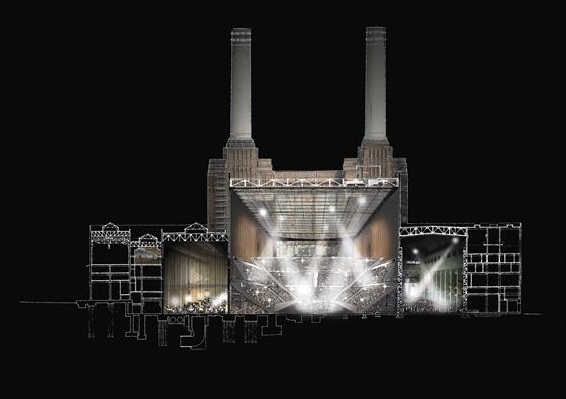
Another plan, by Allies & Morrison (thems what redone the Royal Festival Hall), is to turn BPS into a 11,000-seater concert venue.


From the CG sketches, it looks like much of the brick would be maintained - the bdonline site notes that the 'former coal bunker area and Grade II listed Water Pumping Station will be kept. Housing would be built on surrounding land.'  Ah, housing again.  I wonder how much of that there will be, and quite how close is would be to the trains and venue...  The Morrison proposal also features a really horrible sketch of what appears to be the apocalypse drawn on an Etch-A-Sketch.  Shudder.


What are those lines in the sky?  The vapour trails from incoming warheads?  The very fabric of reality breaking down?


Another proposal for BPS is to use it as Chelsea FC's new stadium.  The Daily Mirror has a lovely 16-bit graphics mock-up image of the results.  I wonder how many fans could be crammed into that space (considering the Morrison venue proposal would host just 11,000). The rest of the grounds would be... 'shops, offices and affordable housing.'  Oh, housing.


You'd've thought they'd bother to landscape the area around the stadium.


All of the above plans seem something of a distraction.  There's no particular interest in BPS itself, just a desire to secure planning permission to build shed loads of flats on some lovely land.

So what do I think should happen to BPS?  Well, I quite fancy turning it into some sort of gated Children of Men Ark of Arts (a sort-of fascist Tate Modern).  

Or, ideally, a really lovely Moderne flat.  For me.

But, before any of this happens, the BPS grounds will be used as a giant car park for itinerant police vehicles during the Olympics.  Woohoo.